
Sustainable Valentine’s Day Chocolate
Is Your Valentine’s Gift Hurting the Planet?
Valentine’s Day has a long and interesting history. Some believe the holiday began with the Roman festival of Lupercalia, a winter celebration that brought people together.
The sweet traditions we know today came much later. In the mid-1800s, Richard Cadbury had a brilliant idea to use excess cocoa butter to create “eating chocolates,” becoming the first to package them in the now-iconic heart-shaped boxes.
But while we still love these boxes today, there is a “bitter” side to our sweets. You might be shocked to learn that traditional chocolate has an incredibly high environmental cost.
The Hidden Cost of Cocoa
Producing chocolate creates a massive amount of greenhouse gases. In fact, chocolate ranks just behind beef for the highest emissions per kilogram of food produced.
Did You Know?
According to Our World in Data, producing 1kg of chocolate emits ~19kg of CO₂. This is largely due to land use changes and deforestation in tropical regions.
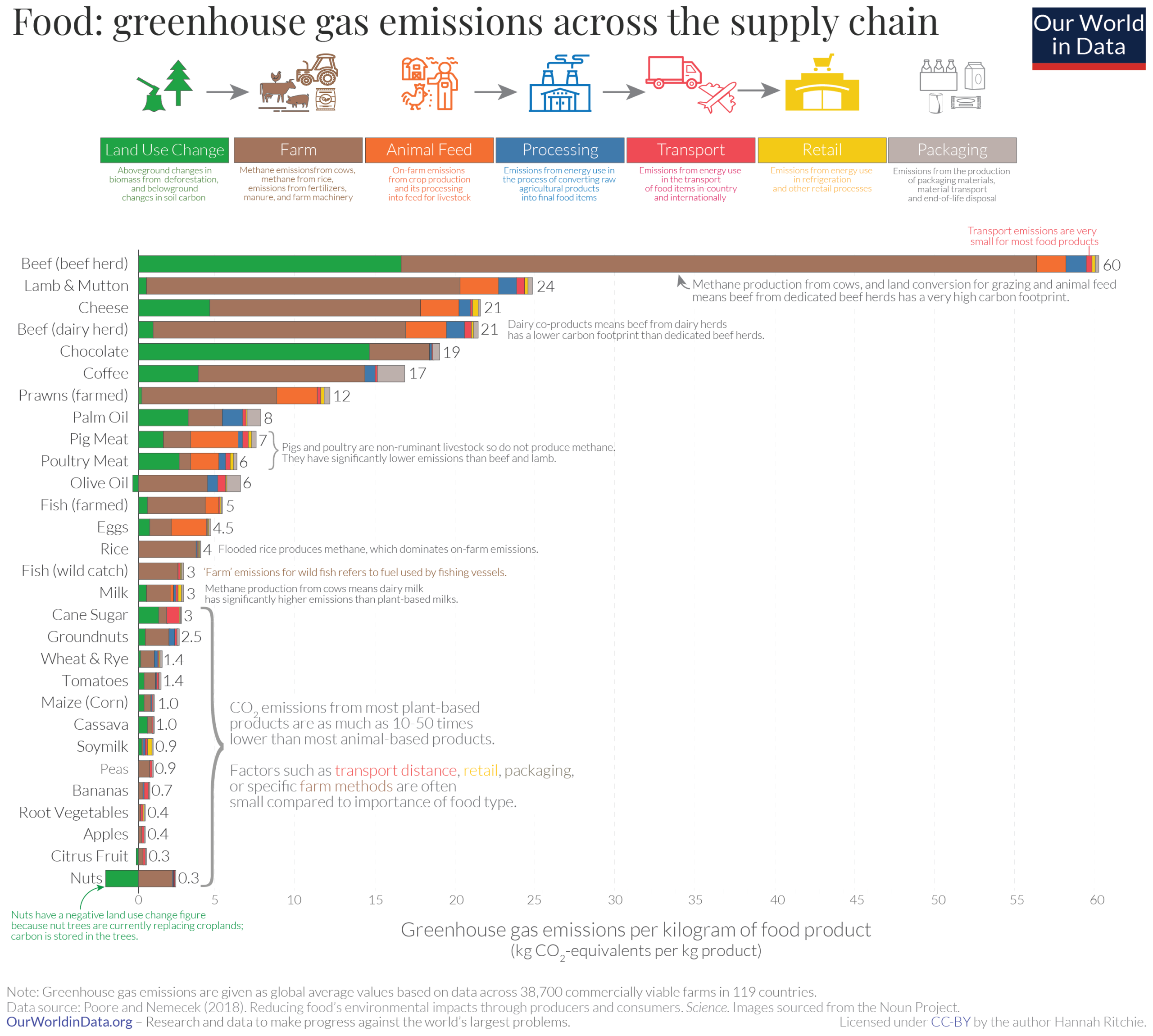
Bar chart by Our World in Data titled ‘Food: greenhouse gas emissions across the supply chain.’ It ranks various foods by their carbon footprint in kg of CO₂ equivalents per kg of product. Beef (beef herd) has the highest emissions at 60kg, while Chocolate is ranked 5th with 19kg of emissions, largely driven by Land Use Change—significantly higher than Palm Oil, which sits lower at 8kg.
This means your sweet gift can have a heavy impact on the planet if you don’t choose carefully. True love involves making conscious choices for your partner and the world.
This year, look beyond the pretty packaging. Choose sustainable Valentine’s Day chocolate made with certified sustainable palm oil and ethically sourced cocoa to protect our forests and farmers.
Because palm oil is found in over 50% of grocery items, avoiding it entirely is often less effective than supporting responsible growth.
The Hidden Cost of Romance: Why Your Choice Matters
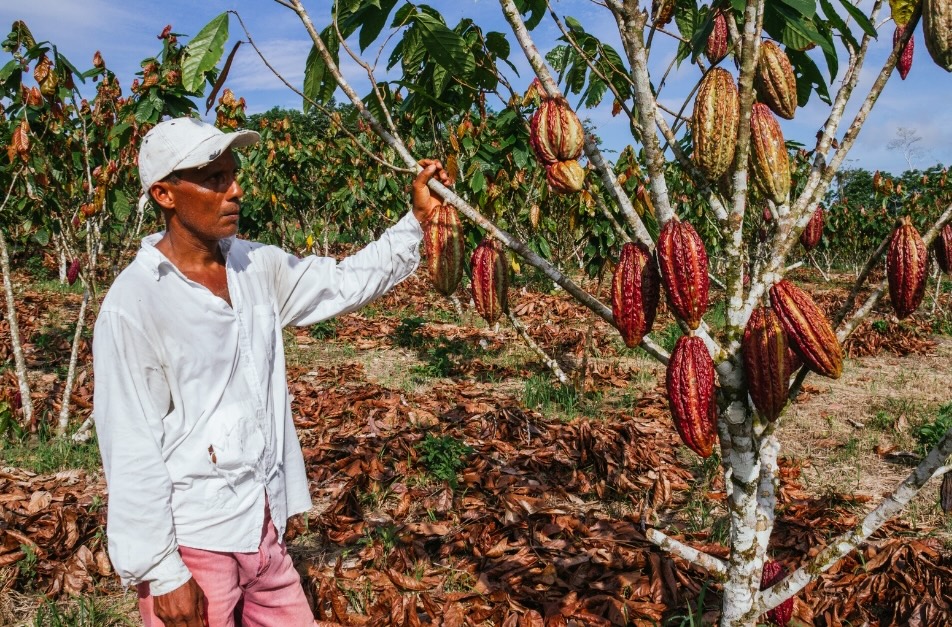
A cocoa farmer inspecting ripe red cacao pods on a tree, representing sustainable farming practices.
The Climate Impact of Cocoa
We often think of chocolate as a simple pleasure, but its production leaves a heavy mark on the planet. Chocolate has a massive carbon footprint, largely due to deforestation and land use changes in tropical regions.
The loss of trees is a major part of this problem. Over the last 60 years, Ivory Coast and Ghana, which grow 60% of the world’s cocoa, have lost between 80% and 94% of their forests. Cocoa farming is responsible for roughly one-third of that total loss.
This destruction creates two critical issues:
- Deforestation: Cutting down rainforests releases massive amounts of stored carbon into the atmosphere, accelerating climate change.
- Child Labor: Driven by poverty, many farmers are forced to rely on minors to survive. According to the U.S. Department of Labor, 1.56 million children work on cocoa farms in Ivory Coast and Ghana alone, often performing hazardous tasks.
Why Is Palm Oil in My Chocolate?
You might notice palm oil listed on the ingredients of your favorite Valentine’s treats. It isn’t there by accident, because it plays a crucial role in creating the chocolate we love.
Palm oil gives chocolate its creamy, melt-in-your-mouth feel. It stays semi-solid at room temperature but melts perfectly at body temperature. It resists oxidation, which acts as a natural preservative to extend the shelf life of your truffles and bars.
Palm oil is free from trans fats. It replaced partially hydrogenated oils (which are harmful to heart health) in many confections.
However, just like cocoa, how it is grown matters. This is why choosing sustainable palm oil is the single most effective way to enjoy your sweets without the guilt.
Why “Boycotting” Isn’t the Most Romantic Option
The Efficiency Argument: Why “Palm Oil Free” Fails
You might think the best way to help the planet is to stop buying products with palm oil. However, simply avoiding this ingredient is often not the most helpful choice.
Oil palm trees are incredibly efficient. In fact, they are the highest-yielding vegetable oil crop on Earth.
Did you know?
Oil palms require 4 to 10 times less land than other crops, like sunflower, soybean, or coconut, to produce the same amount of oil. A single hectare of oil palm trees yields more than twice the oil of a hectare of sunflowers.
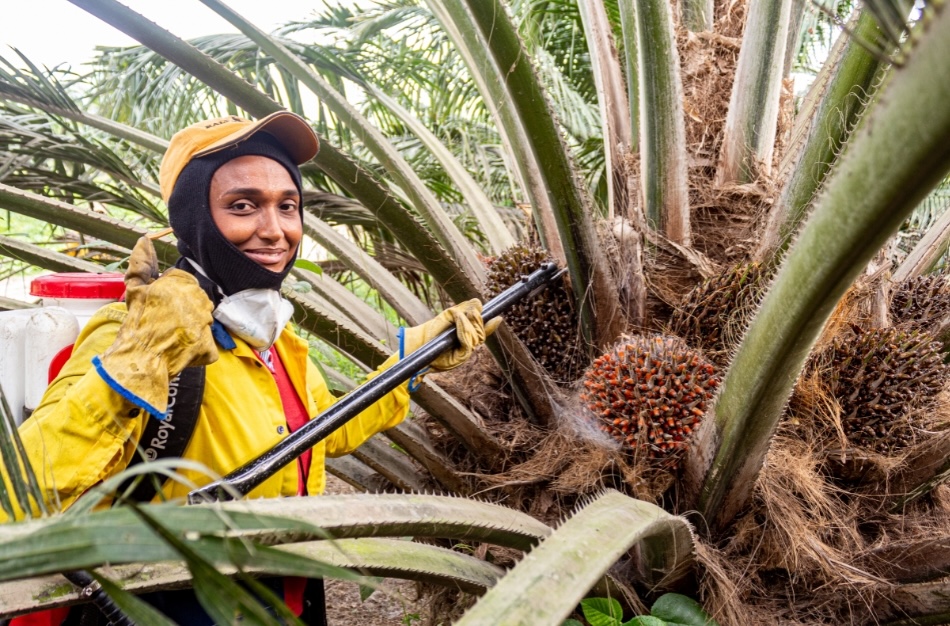
A palm oil worker in protective safety gear giving a thumbs up while harvesting fruit, representing fair labor practices in sustainable agriculture.
Because of this efficiency, boycotting palm oil can actually cause more harm than good:
- The Displacement Problem: Switching to less efficient oils (like coconut or soy) would require much more land, potentially driving more deforestation in other regions. Compare the crops in our guide: Sustainable Palm Oil vs. Coconut Oil.
- Supporting Communities: Sustainable palm oil supports millions of smallholder farmers who rely on the crop for essentials like food, clean water, and education. Meet the farmers who grow your ingredients responsibly.
The Sustainable Solution: Certification & Agroforestry
The solution is not to boycott, but to demand Certified Sustainable Palm Oil (CSPO). This ensures your chocolate is farmed with strict rules that protect animals, forests, and people.
Here is how to find sustainable sweets:
- Look for the RSPO Label: Check packaging for the RSPO trademark. This guarantees that the RSPO certified sustainable palm oil inside was kept 100% separate from conventional oil throughout the entire supply chain, ensuring your chocolate is fully traceable and deforestation-free.
- Support Agroforestry: Some visionary farmers use agroforestry, planting cocoa or palm trees alongside bananas, avocados, and timber. These systems can store 2.5 times more carbon than monoculture farms, actively fighting climate change.
Regenerative agriculture does more than just fight climate change; it actively restores natural habitats. We maintain protected forest corridors to support biodiversity, ensuring that native wildlife and pollinators thrive alongside our crops.
How to Find Ethical Chocolate Brands
Step 1: Check the “Chocolate Scorecard”
One of the fastest ways to ensure your gift is truly ethical is to rely on independent data. We recommend using the Chocolate Scorecard, an annual ranking by the coalition Be Slavery Free.
This scorecard ranks the world’s largest chocolate companies on six critical metrics, including Transparency, Living Income, and Deforestation.
Who are the “Good Eggs”?
In the recent rankings, brands like Tony’s Chocolonely, Beyond Good, COOP, and MARS received top marks for their commitment to traceability and segregated supply chains. Conversely, brands that fail to provide data are often labeled as “broken eggs” a clear signal to conscious consumers.
Step 2: The “Green Flag” Checklist
If you are buying from a smaller boutique or a brand not on the scorecard, look for these three “Green Flags” on the packaging or website:
- Traceability (The Gold Standard):
Don’t just look for “sustainable.” Look for traceability. Leading brands use satellite monitoring (like Starling technology) to prove their farms are deforestation-free. - Segregated Ingredients:
Do not be afraid of palm oil in your chocolate, be afraid of untraceable palm oil. Look for brands that use RSPO Certified palm oil.- What this means: The sustainable oil is kept physically separate from non-certified oil throughout the entire supply chain, ensuring 100% of what you eat is responsible.
- Third-Party Certifications:
Verify claims with recognized logos. The most rigorous for chocolate lovers include:- RSPO (Roundtable on Sustainable Palm Oil) for deforestation-free ingredients.
- Fairtrade or Rainforest Alliance for farmer welfare and cocoa standards.
For a deeper dive into how these standards protect the planet, read about Responsible Palm Oil Production.
Make This Valentine’s Day Count
Valentine’s Day is a celebration of love. But true romance should extend beyond your partner, it should show love to the environment and the farmers who produce our gifts.
By choosing sustainable chocolate, you help halt deforestation and support fair labor practices without sacrificing the treats you love. Strict rules in sustainable farming ensure that animals, forests, and workers are protected.
📝 Your Sustainable Shopping List
Before you head to the store this February 14th, keep these three rules in mind:
- Check the Scorecard: Use the Chocolate Scorecard to spot industry leaders.
- Verify the Label: Look for the RSPO or Fairtrade logo on the back.
- Vote with Your Wallet: Support brands that offer transparency, even if it costs a few cents more.
This year, verify your Valentine. Choose brands that care about the planet as much as you do.